DDTrace
DataKit 的 ddtrace 采集器是一个 DataDog Trace 协议接收端:应用内的 DDTrace SDK 或 Java Agent 将 trace 通过 HTTP 发送给 DataKit,DataKit 再解析、处理并上报这些数据。它不会替应用安装 SDK,也不会替代应用侧的插桩。
数据链路如下:
应用代码 → DDTrace SDK / Java Agent → DataKit HTTP 接收端 → 观测云
链路、Profiling 数据和运行时/JMX 指标使用的接收端不同:
- Trace 由本采集器接收,默认使用 DataKit HTTP 端口
9529; - Profiling 需要单独开启 Profiling 采集器;
- JMX、runtime metrics 等 DogStatsD 指标需要单独开启 StatsD 采集器,通常使用
8125端口。
使用前请确认
- DataKit 已安装并已启用本采集器;应用侧也已按所用语言完成 SDK 或 Agent 的插桩。
- 应用与 DataKit 的网络连通。DataKit 默认仅监听
localhost:9529;应用不在同一主机或同一 Pod 时,需调整 HTTP 服务监听地址 并通过防火墙、Kubernetes Service 或 NetworkPolicy 限制访问范围。 - 显式将应用侧的 trace 目标设置为 DataKit 地址和端口,例如
DD_AGENT_HOST=<datakit-host>、DD_TRACE_AGENT_PORT=9529。上游 Datadog Agent 的常见默认端口是8126,不要依赖默认值,也不要把 StatsD 的8125当作 trace 端口。 - 为服务设置稳定的
DD_SERVICE、DD_ENV和DD_VERSION;这三个维度决定服务、环境和版本在链路视图中的归属。
按语言接入
配置
本节配置的是 DataKit 接收端。应用侧 SDK 的地址、服务名、采样等配置仍需在应用的启动参数或环境变量中设置,具体见对应语言文档。
进入 DataKit 安装目录下的 conf.d/samples 目录,复制 ddtrace.conf.sample 并命名为 ddtrace.conf。示例如下:
[[inputs.ddtrace]]
  ## DDTrace Agent endpoints register by version respectively.
  ## Endpoints can be skipped listen by remove them from the list.
  ## NOTE: DO NOT EDIT.
  endpoints = ["/v0.3/traces", "/v0.4/traces", "/v0.5/traces"]

  ## customer_tags will work as a whitelist to prevent tags send to data center.
  ## All . will replace to _ ,like this :
  ## "project.name" to send to center is "project_name"
  # customer_tags = ["sink_project", "custom_dd_tag", "reg:key_*"]

  ## Keep rare tracing resources list switch.
  ## If some resources are rare enough(not presend in 1 hour), those resource will always send
  ## to data center and do not consider samplers and filters.
  # keep_rare_resource = false

  ## By default every error presents in span will be send to data center and omit any filters or
  ## sampler. If you want to get rid of some error status, you can set the error status list here.
  # omit_err_status = ["404"]

  ## compatible otel: It is possible to compatible OTEL Trace with DDTrace trace.
  ## make span_id and parent_id to hex encoding.
  # compatible_otel=true

  ##  It is possible to compatible B3/B3Multi TraceID with DDTrace.
  # trace_id_64_bit_hex=true

  ## api:/telemetry/proxy/api/v2/apmtelemetry is collect jvm metadata.
  ## data is: app-dependencies-loaded,app-client-configuration-change,app-integrations-change ...
  ## default is true.
  # apmtelemetry_route_enable = true

  ## When true, the tracer generates 128 bit Trace IDs,
  ## and encodes Trace IDs as 32 lowercase hexadecimal characters with zero padding.
  ## default is true.
  # trace_128_bit_id = true

  ## delete trace message
  # del_message = true

  ## max spans limit on each trace. default 100000 or set to -1 to remove this limit.
  # trace_max_spans = 100000

  ## max trace body(Content-Length) limit. default 32MiB or set to -1 to remove this limit.
  # max_trace_body_mb = 32

  ## tracing_metric_enable: trace_hits trace_hits_by_http_status trace_latency trace_errors trace_errors_by_http_status trace_apdex.
  ## Extract the above metrics from the collection traces.
  # tracing_metric_enable = true

  ## Blacklist of metric tags: There are many labels in the metric: "tracing_metrics".
  ## If you want to remove certain tag, you can use the blacklist to remove them.
  ## By default, it includes: source,span_name,env,service,status,version,resource,http_status_code,http_status_class
  ## and "customer_tags", k8s related tags, and others service.
  # tracing_metric_tag_blacklist = ["resource","operation","tag_x"]

  ## Whitelist of metric tags: There are many labels in the metric: "tracing_metrics".
  # tracing_metric_tag_whitelist = []

  ## Ignore tracing resources map like service:[resources...].
  ## The service name is the full service name in current application.
  ## The resource list is regular expressions uses to block resource names.
  ## If you want to block some resources universally under all services, you can set the
  ## service name as "*". Note: double quotes "" cannot be omitted.
  # [inputs.ddtrace.close_resource]
  #   service1 = ["resource1", "resource2", ...]
  #   service2 = ["resource1", "resource2", ...]
  #   "*" = ["close_resource_under_all_services"]
  #   ...

  ## Sampler config uses to set global sampling strategy.
  ## sampling_rate used to set global sampling rate.
  # [inputs.ddtrace.sampler]
  #   sampling_rate = 1.0

  # [inputs.ddtrace.tags]
  #   key1 = "value1"
  #   key2 = "value2"
  #   ...

  ## Threads config controls how many goroutines an agent cloud start to handle HTTP request.
  ## buffer is the size of jobs' buffering of worker channel.
  ## threads is the total number fo goroutines at running time.
  # [inputs.ddtrace.threads]
  #   buffer = 100
  #   threads = 8

  ## Storage config a local storage space in hard dirver to cache trace data.
  ## path is the local file path used to cache data.
  ## capacity is total space size(MB) used to store data.
  # [inputs.ddtrace.storage]
  #   path = "./ddtrace_storage"
  #   capacity = 5120
配置好后,重启 DataKit 即可。
可通过 ConfigMap 方式注入采集器配置 或 配置 ENV_DATAKIT_INPUTS 开启采集器。
也支持以环境变量的方式修改配置参数(需要在 ENV_DEFAULT_ENABLED_INPUTS 中加为默认采集器):
-
ENV_INPUT_DDTRACE_ENDPOINTS
代理端点
字段类型: JSON
采集器配置字段:
endpoints示例:
'["/v0.3/traces", "/v0.4/traces", "/v0.5/traces"]' -
ENV_INPUT_DDTRACE_CUSTOMER_TAGS
标签白名单
字段类型: JSON
采集器配置字段:
customer_tags示例:
'["sink_project", "custom_dd_tag"]' -
ENV_INPUT_DDTRACE_KEEP_RARE_RESOURCE
保持稀有跟踪资源列表
字段类型: Boolean
采集器配置字段:
keep_rare_resource默认值: false
-
ENV_INPUT_DDTRACE_COMPATIBLE_OTEL
将
otel Trace与DDTrace Trace兼容字段类型: Boolean
采集器配置字段:
compatible_otel默认值: false
-
ENV_INPUT_DDTRACE_TRACE_ID_64_BIT_HEX
将
B3/B3Multi-TraceID与DDTrace兼容字段类型: Boolean
采集器配置字段:
trace_id_64_bit_hex默认值: false
-
ENV_INPUT_DDTRACE_TRACE_128_BIT_ID
将链路 ID 转成长度为 32 的 16 进制编码的字符串
字段类型: Boolean
采集器配置字段:
trace_128_bit_id默认值: true
-
ENV_INPUT_DDTRACE_DEL_MESSAGE
删除 trace 消息
字段类型: Boolean
采集器配置字段:
del_message默认值: false
-
ENV_INPUT_DDTRACE_TRACING_METRIC_ENABLE
开启请求计数,错误计数和延迟指标的采集
字段类型: Boolean
采集器配置字段:
tracing_metric_enable默认值: false
-
ENV_INPUT_DDTRACE_APMTELEMETRY_ROUTE_ENABLE
开启路由
/telemetry/proxy/api/v2/apmtelemetry并接收 JVM 数据字段类型: Boolean
采集器配置字段:
apmtelemetry_route_enable默认值: true
-
ENV_INPUT_DDTRACE_TRACING_METRIC_TAG_BLACKLIST
指标集 tracing_metrics 中标签的黑名单
字段类型: JSON
采集器配置字段:
tracing_metric_tag_blacklist示例:
'["tag_a", "tag_b"]' -
ENV_INPUT_DDTRACE_TRACING_METRIC_TAG_WHITELIST
指标集 tracing_metrics 中标签的白名单
字段类型: JSON
采集器配置字段:
tracing_metric_tag_whitelist示例:
'["tag_c", "tag_d"]' -
ENV_INPUT_DDTRACE_OMIT_ERR_STATUS
错误状态白名单
字段类型: JSON
采集器配置字段:
omit_err_status示例:
'["404", "403", "400"]' -
ENV_INPUT_DDTRACE_CLOSE_RESOURCE
忽略指定服务器的 tracing(正则匹配)
字段类型: JSON
采集器配置字段:
close_resource示例:
'{"service1":["resource1","other"],"service2":["resource2","other"]}' -
ENV_INPUT_DDTRACE_SAMPLER
全局采样率
字段类型: Float
采集器配置字段:
sampler示例: 0.3
-
ENV_INPUT_DDTRACE_THREADS
线程和缓存的数量
字段类型: JSON
采集器配置字段:
threads示例:
'{"buffer":1000, "threads":100}' -
ENV_INPUT_DDTRACE_STORAGE
本地缓存路径和大小(MB)
字段类型: JSON
采集器配置字段:
storage示例:
'{"storage":"./ddtrace_storage", "capacity": 5120}' -
ENV_INPUT_DDTRACE_TAGS
自定义标签。如果配置文件有同名标签,将会覆盖它
字段类型: JSON
采集器配置字段:
tags示例:
'{"k1":"v1", "k2":"v2", "k3":"v3"}' -
ENV_INPUT_DDTRACE_ENV_INPUT_DDTRACE_MAX_SPANS
单个 trace 最大 span 个数,如果超过该限制,多余的 span 将截断,置为 -1 可关闭该限制
字段类型: Int
采集器配置字段:
env_input_ddtrace_max_spans示例: 1000
默认值: 100000
-
ENV_INPUT_DDTRACE_ENV_INPUT_DDTRACE_MAX_BODY_MB
单个 trace API 请求最大 body 字节数(单位 MiB),置为 -1 可关闭该限制
字段类型: Int
采集器配置字段:
env_input_ddtrace_max_body_mb示例: 32
默认值: 10
customer_tags 用于将指定的 meta 字段提升为一级标签。普通字段名中的 . 会自动转为 _,例如 http.route 会变为 http_route。正则必须以 reg: 开头,并使用 Go 正则表达式;例如 reg:^key_.*$ 匹配所有以 key_ 开头的字段。请先在测试环境验证正则,非法表达式会使采集器无法正常初始化。
多线路工具串联注意事项
DDTrace 传统 Trace ID 为 64 位整数;W3C tracecontext 使用 128 位、32 个十六进制字符的 Trace ID。DDTrace 载荷会把高 64 位放在 _dd.p.tid 中,DataKit 需要据此重建完整的 128 位 ID。
请让调用链上的 SDK 使用一致的透传协议,并按实际协议配置 DataKit:
- 使用
tracecontext与 OpenTelemetry 串联时,启用compatible_otel=true,以十六进制格式输出 span 和父 span ID;trace_128_bit_id默认已启用,用于拼接_dd.p.tid与低 64 位 Trace ID。 - 使用
b3multi且上游发送 64 位十六进制 Trace ID 时,启用trace_id_64_bit_hex=true。 - 变更协议后,用一个跨服务请求验证 Trace ID 与 parent ID 是否连续;协议不一致通常表现为服务拓扑断开,而不是 DataKit 收不到数据。
更多协议组合见多链路串联。
Info
compatible_otel:将span_id和parent_id输出为十六进制字符串。trace_128_bit_id:将meta中的_dd.p.tid与低 64 位trace_id拼接为 32 位十六进制字符串;默认值为true。trace_id_64_bit_hex:将上游 64 位十六进制trace_id按十六进制解析。
注入 Pod 和 Node 信息
当应用部署在 Kubernetes 等容器环境时,可通过 Downward API 将 Pod、Namespace 和 Node 信息写入 DD_TAGS。这些字段会随应用侧 span 发送;如需在链路列表中作为一级标签筛选,再在 DataKit 的 customer_tags 中显式添加相应字段。
---
apiVersion: apps/v1
kind: Deployment
metadata:
  name: my-app
spec:
  selector:
    matchLabels:
      app: my-app
  replicas: 3
  template:
    metadata:
      labels:
        app: my-app
        service: my-service
    spec:
      containers:
        - name: my-app
          image: my-app:v0.0.1
          env:
            - name: POD_NAME
              valueFrom:
                fieldRef:
                  fieldPath: metadata.name
            - name: NODE_NAME
              valueFrom:
                fieldRef:
                  fieldPath: spec.nodeName
            - name: POD_NAMESPACE
              valueFrom:
                fieldRef:
                  fieldPath: metadata.namespace
            - name: DD_TAGS
              value: pod_name:$(POD_NAME),pod_namespace:$(POD_NAMESPACE),host:$(NODE_NAME)
            - name: DD_SERVICE
              valueFrom:
                fieldRef:
                  fieldPath: metadata.labels['service']
变量替换只能引用同一容器中先定义的环境变量,因此应先定义 POD_NAME、POD_NAMESPACE 和 NODE_NAME,再定义 DD_TAGS。
应用启动后,进入对应的 Pod,我们可以验证 ENV 是否生效:
一旦注入成功,在最终的 Span 数据中,我们就能看到该 Span 所处的 Pod 以及 Node 名称。
Warning
- 不要修改这里的
endpoints列表(除非明确知道配置逻辑和效果)。
- DataKit 的
[inputs.ddtrace.sampler]是接收端采样,与 SDK 的DD_TRACE_SAMPLE_RATE相互独立。要让接收端不再采样,请删除或完整注释该表;若保留该表,必须显式设置采样率:
sampling_rate = 1.0 表示保留全部 trace。不要只注释 sampling_rate 而保留表头,否则该表会按零值处理并丢弃所有 trace。默认情况下错误 trace 会绕过接收端采样;如配置 omit_err_status,对应 HTTP 错误状态才可能被过滤。
HTTP 设置
DataKit 默认监听 localhost:9529。若 trace 来自远端主机或其他 Pod,需要在 datakit.conf 的 [http_api] 中设置应用可达的监听地址,例如:
仅在受控网络中使用该配置:trace 端点不应直接暴露到公网,生产环境应使用防火墙、安全组、Kubernetes Service/NetworkPolicy 或 TLS 进行访问控制。DataKit 默认接收 /v0.3/traces、/v0.4/traces 和 /v0.5/traces,除非明确了解兼容性影响,否则不要修改 endpoints。
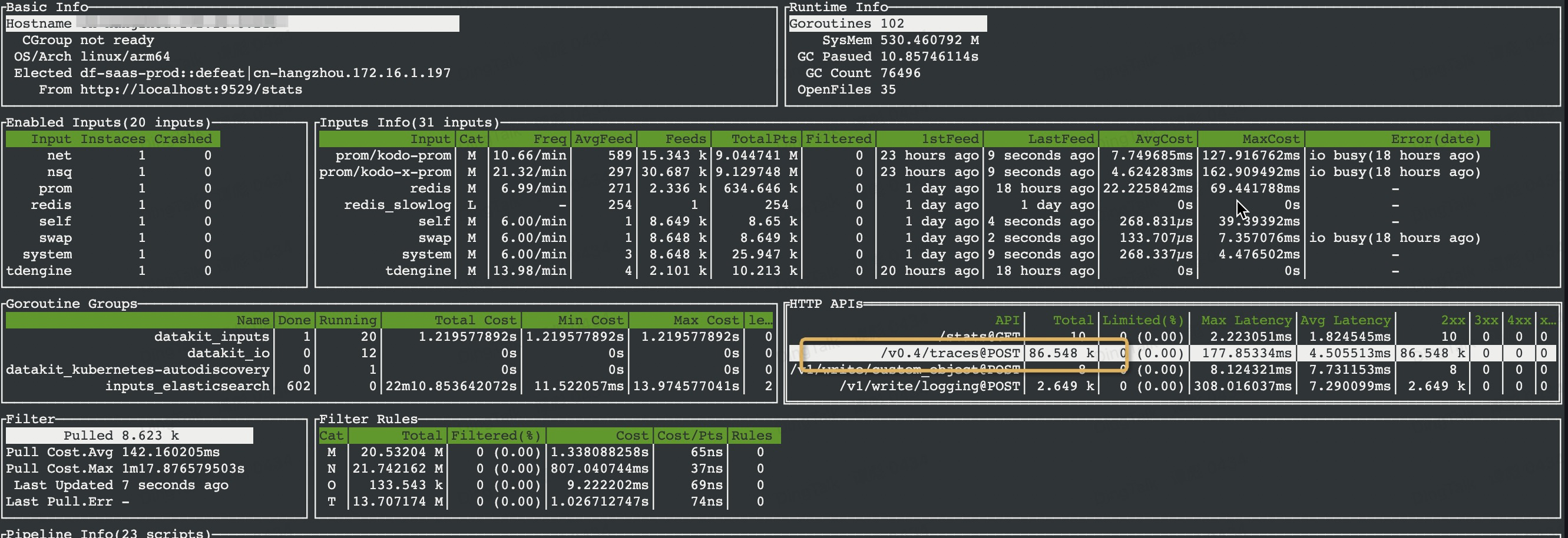
如果有 DDTrace 数据发送给 DataKit,那么在 DataKit 的 monitor 上能看到:
开启磁盘缓存
磁盘缓存用于在瞬时流量较高时延后处理 HTTP 请求体,降低内存和处理峰值;它不是长期归档,也不能替代应用侧采样。目录必须可写、具备足够空间,并应位于容器重建后仍可保留的卷上(如确有恢复需求)。capacity 单位为 MiB。
DDtrace SDK 配置
配置完采集器后,再配置 SDK。不同语言对变量的支持和优先级略有差异;下列变量是通用概念,最终以所用语言 SDK 的版本文档为准。若 SDK 支持 DD_TRACE_AGENT_URL,该 URL 通常优先于主机和端口配置,避免同时设置相互冲突的值。
环境变量设置
| 变量 | 用途 | 使用建议 |
|---|---|---|
DD_AGENT_HOST、DD_TRACE_AGENT_PORT |
Trace 接收端地址和端口 | 指向 DataKit,例如 datakit-service:9529;不要误用 StatsD 端口 8125。 |
DD_SERVICE、DD_ENV、DD_VERSION |
服务、环境和版本标识 | 在所有服务中使用稳定、可检索的值。 |
DD_TAGS |
应用侧全局标签 | 使用 key:value 对;避免写入令牌、请求体、个人信息等敏感数据。 |
DD_TRACE_SAMPLE_RATE |
SDK 侧采样率 | 0.0 到 1.0;优先在源头控制高流量。 |
DD_TRACE_ENABLED |
是否启用插桩/trace 发送 | 具体行为因语言而异,排障时确认没有被设为 false。 |
DD_TRACE_STARTUP_LOGS、DD_TRACE_DEBUG |
SDK 启动与调试日志 | 仅在排障期间临时开启,避免增加日志量或暴露配置细节。 |
除了在应用初始化时设置项目名,环境名以及版本号外,还可通过如下两种方式设置:
- 通过命令行注入环境变量
- 在 ddtrace.conf 中直接配置接收端标签。这种方式会影响所有进入该 DataKit 的 DDTrace 数据,适合注入统一的部署标签;不要用它表达某个应用独有的服务信息:
# tags is ddtrace configed key value pairs
[inputs.ddtrace.tags]
  some_tag = "some_value"
  more_tag = "some_other_value"
APMTelemetry
Java Agent 可以通过 /telemetry/proxy/api/v2/apmtelemetry 上报启动配置、心跳、依赖与已加载集成等元数据。DataKit 默认接收该路由;如不需要,可关闭 apmtelemetry_route_enable。数据可在 观测云 基础设施的资源目录中查看,适合排查启动命令、依赖版本和探针加载情况。
语言不同和版本不同数据可能会有很大的差异,以实际收到的数据为准。
固定提取 tag
从 DataKit 版本 1.21.0 开始,不再把 Span.Meta 的所有字段提升为一级标签,而是仅提取下列常用字段,以控制标签基数和索引成本。
以下是可能会提取出的标签列表:
| 原始 Meta 字段 | 提取出来的字段名 | 说明 |
|---|---|---|
http.url |
http_url |
HTTP 请求完整路径 |
http.hostname |
http_hostname |
hostname |
http.route |
http_route |
路由 |
http.status_code |
http_status_code |
状态码 |
http.method |
http_method |
请求方法 |
http.client_ip |
http_client_ip |
客户端 IP |
sampling.priority |
sampling_priority |
采样 |
span.kind |
span_kind |
span 类型 |
error |
error |
是否错误 |
runtime.name |
runtime_name |
运行时名称 |
dd.version |
dd_version |
agent 版本 |
error.message |
error_message |
错误信息 |
error.stack |
error_stack |
堆栈信息 |
error.type |
error_type |
错误类型 |
system.pid |
pid |
pid |
error.msg |
error_message |
错误信息 |
project |
project |
project |
version |
version |
版本 |
env |
env |
环境 |
host |
host |
tag 中的主机名 |
pod_name |
pod_name |
tag 中的 pod 名称 |
pod_namespace |
pod_namespace |
tag 中的 pod 名称 |
_dd.base_service |
_dd_base_service |
上级服务 |
peer.hostname |
db_host |
可能是 IP 或者域名,这取决于配置 |
db.type |
db_system |
数据库类型: mysql oracle 等等 |
db.instance |
db_name |
数据库名称 |
out.host |
out_host |
链接中间件的 Host |
dd_ext_version |
sdk_version |
SDK 扩展版本号 |
language |
sdk_language |
SDK 语言 |
未在列表中的字段仍保留在 span 的 meta 中,可在链路详情中查看;是否能作为一级标签筛选取决于界面与索引配置。
从 DataKit 版本 1.22.0 起,可通过 customer_tags 增加白名单字段。提取后字段名中的 . 会变成 _;请只添加稳定且低基数的字段,避免把用户 ID、请求 ID 等高基数字段提升为标签。
常见排障路径
| 现象 | 优先检查项 |
|---|---|
| 完全没有 trace | DataKit 的 ddtrace 是否启用;应用是否真的加载 SDK/Agent;DD_AGENT_HOST、DD_TRACE_AGENT_PORT、Service、NetworkPolicy 和防火墙是否正确。 |
| 只有部分服务或调用链断开 | 上下游的透传协议是否一致;tracecontext/B3 对应的 DataKit ID 兼容开关是否正确。 |
| JVM 指标或 Profiling 缺失 | 它们不由本采集器接收;分别检查 statsd 或 profile 采集器和对应端口。 |
| 数据量或资源占用过高 | 先缩小应用侧采样,再评估接收端采样、trace_max_spans、max_trace_body_mb 与磁盘缓存。 |
数据采集字段说明
链路
ddtrace
以下是采集上来的 tracing 字段说明
| Tags & Fields | Description |
|---|---|
| base_service ( tag) |
Span base service name |
| container_host ( tag) |
Container hostname. Available in OpenTelemetry. Optional. |
| db_host ( tag) |
DB host name: ip or domain name. Optional. |
| db_name ( tag) |
Database name. Optional. |
| db_system ( tag) |
Database system name:mysql,oracle... Optional. |
| dk_fingerprint ( tag) |
DataKit fingerprint(always DataKit's hostname) |
| endpoint ( tag) |
Endpoint info. Available in SkyWalking, Zipkin. Optional. |
| env ( tag) |
Application environment info. Available in Jaeger. Optional. |
| host ( tag) |
Hostname. |
| http_method ( tag) |
HTTP request method name. Available in DDTrace, OpenTelemetry. Optional. |
| http_route ( tag) |
HTTP route. Optional. |
| http_status_code ( tag) |
HTTP response code. Available in DDTrace, OpenTelemetry. Optional. |
| http_url ( tag) |
HTTP URL. Optional. |
| operation ( tag) |
Span name |
| out_host ( tag) |
This is the database host, equivalent to db_host,only DDTrace-go. Optional. |
| project ( tag) |
Project name. Available in Jaeger. Optional. |
| service ( tag) |
Service name. Optional. |
| source_type ( tag) |
Tracing source type |
| span_type ( tag) |
Span type |
| status ( tag) |
Span status |
| version ( tag) |
Application version info. Available in Jaeger. Optional. |
| duration | Duration of span Type: int | (gauge) Unit: time,μs |
| message | Origin content of span Type: string Unit: N/A |
| parent_id | Parent span ID of current span Type: string Unit: N/A |
| resource | Resource name produce current span Type: string Unit: N/A |
| span_id | Span id Type: string Unit: N/A |
| start | start time of span. Type: int | (gauge) Unit: timeStamp,usec |
| trace_id | Trace id Type: string Unit: N/A |
指标
tracing_metrics
基于 DDTrace 统计得到的指标数据,它记录了所产生的 span 计数、span 耗时等指标
| Tags & Fields | Description |
|---|---|
| collector_source_ip ( tag) |
Remote agent IP. |
| env ( tag) |
Application environment info(if set in span). |
| host ( tag) |
Hostname. |
| http_status_class ( tag) |
HTTP response code class, such as 2xx/3xx/4xx/5xx |
| http_status_code ( tag) |
HTTP response code |
| operation ( tag) |
Span name |
| pod_name ( tag) |
Pod name(if set in span). |
| pod_namespace ( tag) |
Pod namespace(if set in span). |
| project ( tag) |
Project name(if set in span). |
| resource ( tag) |
Application resource name. |
| service ( tag) |
Service name. |
| source ( tag) |
Source, always ddtrace |
| status ( tag) |
Span status(ok/error) |
| version ( tag) |
Application version info. |
| apdex | Measures the Apdex score for each web service. The currently set satisfaction threshold is 2 seconds.The tags for this metric are fixed: service/env/version/resource/source. The value range is 0~1.Type: float | (gauge) Unit: N/A |
| errors | Represent the count of errors for spans. Type: int | (gauge) Unit: count |
| errors_by_http_status | Represent the count of errors for a given span group by HTTP status code. Type: int | (gauge) Unit: count |
| hits | Count of spans. Type: int | (count) Unit: count |
| hits_by_http_status | Represent the count of hits for a given span group by HTTP status code. Type: int | (gauge) Unit: count |
| latency_bucket | Represent the latency distribution for all services, resources, and versions across different environments and additional primary tags. Recommended for all latency measurement use cases. Use the 'le' tag for filtering Type: int | (histogram) Unit: count |
| latency_count | The number of spans is equal to the number of web type spans. Type: int | (count) Unit: count |
| latency_sum | The total latency of all web spans, corresponding to the 'latency_count' Type: int | (gauge) Unit: time,μs |
资源对象
扩展版 Java Agent 启动后可上报自身配置、集成列表、依赖关系和服务元数据。当前该类资源对象仅适用于 Java Agent,常见事件如下:
app_client_configuration_change其中包含 Agent 的配置信息app_dependencies_loaded依赖列表,包括包名和版本信息app_integrations_change集成列表,包括包名和是否开启探针- 其他主机信息和服务等信息
tracing_service
采集 DDTrace 的 Service、Host、进程等配置信息
| Tags & Fields | Description |
|---|---|
| architecture ( tag) |
Architecture |
| env ( tag) |
Service ENV |
| hostname ( tag) |
Host name |
| kernel_name ( tag) |
Kernel name |
| kernel_release ( tag) |
Kernel release |
| kernel_version ( tag) |
Kernel version |
| language_name ( tag) |
Language name |
| language_version ( tag) |
Language version |
| name ( tag) |
Same as service name |
| os ( tag) |
OS name |
| os_version ( tag) |
OS version |
| runtime_id ( tag) |
Runtime ID |
| runtime_name ( tag) |
Runtime name |
| runtime_patches ( tag) |
Runtime patches |
| runtime_version ( tag) |
Runtime version |
| service ( tag) |
Service |
| service_version ( tag) |
Service version |
| tracer_version ( tag) |
DDTrace version |
| app_client_configuration_change | JSON payload from a DDTrace APM telemetry client-configuration-change request. Type: string | (string) Unit: N/A |
| app_closing | JSON payload from a DDTrace APM telemetry app-closing request. Type: string | (string) Unit: N/A |
| app_dependencies_loaded | JSON payload containing dependencies loaded by the traced application. Type: string | (string) Unit: N/A |
| app_integrations_change | JSON payload from a DDTrace APM telemetry integrations-change request. Type: string | (string) Unit: N/A |
| app_started | JSON payload from the DDTrace APM telemetry app-started request. Type: string | (string) Unit: N/A |
| spans_created | Number of spans created by the traced application as reported by DDTrace telemetry. Type: float | (count) Unit: count |
| spans_finished | Number of spans finished by the traced application as reported by DDTrace telemetry. Type: float | (count) Unit: count |