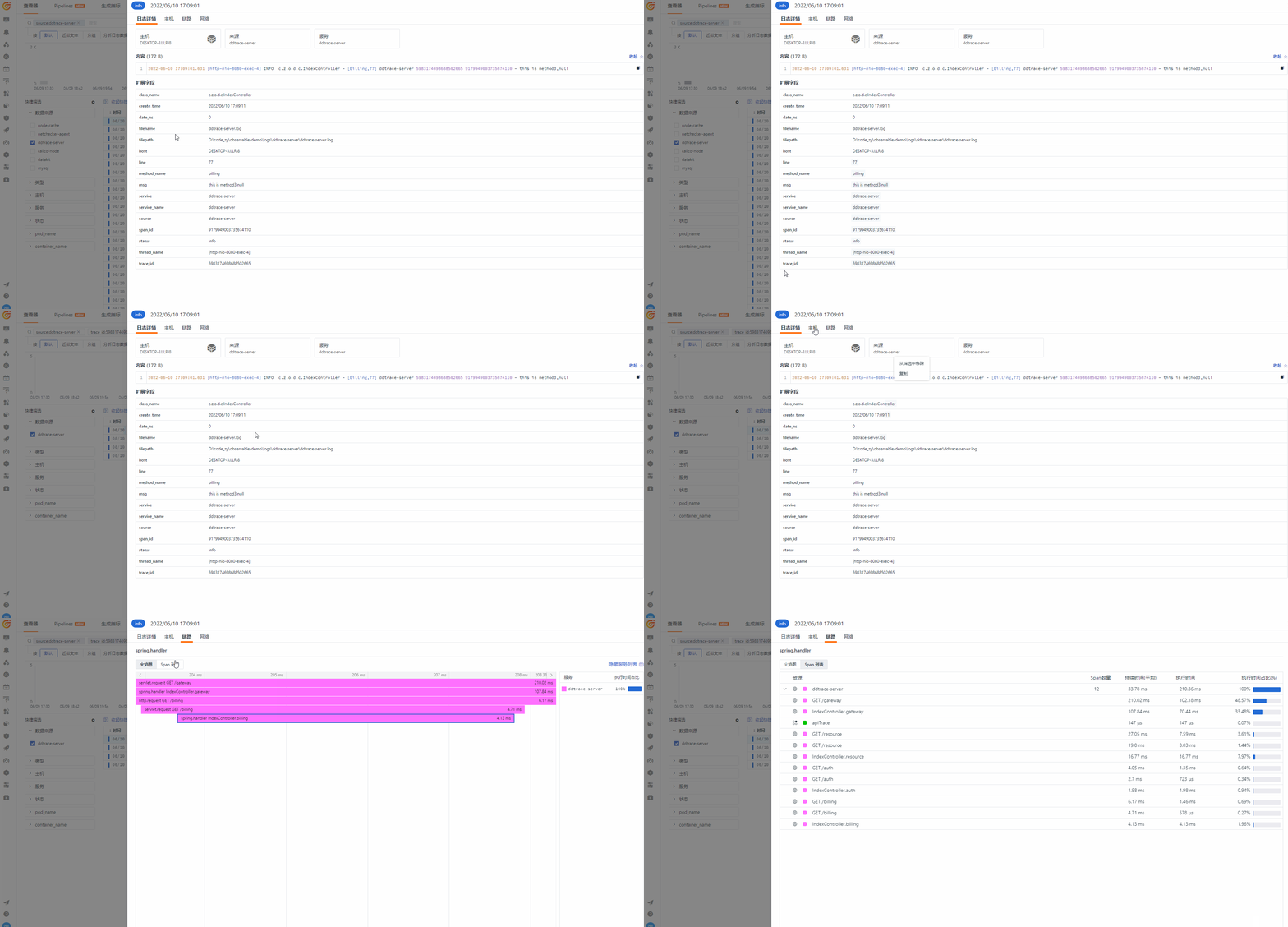
ddtrace Log Correlation
Warning
The current example is tested with ddtrace version 0.114.0 (latest version)
Preconditions
- Enable the DataKit ddtrace collector
- Prepare Shell
java -javaagent:D:/ddtrace/dd-java-agent-0.114.0.jar \
-Ddd.service.name=ddtrace-server \
-Ddd.agent.port=9529 \
-jar springboot-ddtrace-server.jar
Note:
- Trace and log correlation is achieved through MDC injection.
- No jar dependency is required here; the ddtrace agent injects MDC fields.
Installation and Deployment
Using logback-spring.xml as an example
1 logback-spring.xml
<?xml version="1.0" encoding="UTF-8"?>
<configuration scan="true" scanPeriod="30 seconds">
    <!-- Some parameters come from the properties file -->
    <springProperty scope="context" name="logName" source="spring.application.name" defaultValue="localhost.log"/>
    <!-- After configuration, log levels can be dynamically modified -->
    <jmxConfigurator />
    <property name="log.pattern" value="%d{yyyy-MM-dd HH:mm:ss.SSS} [%thread] %-5level %logger{20} - [%method,%line] %X{dd.service} %X{dd.trace_id} %X{dd.span_id} - %msg%n" />

    <!-- %m: message, %p: log level, %t: thread name, %d: date, %c: fully qualified class name -->
    <appender name="STDOUT" class="ch.qos.logback.core.ConsoleAppender">
        <encoder>
            <pattern>${log.pattern}</pattern>
            <charset>UTF-8</charset>
        </encoder>
    </appender>

    <appender name="FILE" class="ch.qos.logback.core.rolling.RollingFileAppender">
        <file>logs/${logName}/${logName}.log</file>    <!-- Usage -->
        <append>true</append>
        <rollingPolicy class="ch.qos.logback.core.rolling.SizeAndTimeBasedRollingPolicy">
            <fileNamePattern>logs/${logName}/${logName}-%d{yyyy-MM-dd}.log.%i</fileNamePattern>
            <maxFileSize>64MB</maxFileSize>
            <maxHistory>30</maxHistory>
            <totalSizeCap>1GB</totalSizeCap>
        </rollingPolicy>
        <encoder>
            <pattern>${log.pattern}</pattern>
            <charset>UTF-8</charset>
        </encoder>
    </appender>

    <!-- Only print ERROR level content -->
    <logger name="com.netflix" level="ERROR" />
    <logger name="net.sf.json" level="ERROR" />
    <logger name="org.springframework" level="ERROR" />
    <logger name="springfox" level="ERROR" />

    <!-- SQL printing configuration -->
    <logger name="com.github.pagehelper.mapper" level="DEBUG" />
    <logger name="org.apache.ibatis" level="DEBUG" />

    <root level="info">
        <appender-ref ref="STDOUT" />
        <appender-ref ref="FILE" />
    </root>
</configuration>
The log format is configured via the pattern:
%d{yyyy-MM-dd HH:mm:ss.SSS} [%thread] %-5level %logger{20} - [%method,%line] %X{dd.service} %X{dd.trace_id} %X{dd.span_id} - %msg%n
2022-06-10 17:07:45.257 [main] INFO  o.a.c.c.StandardEngine - [log,173] ddtrace-server   - Starting Servlet engine: [Apache Tomcat/9.0.56]
2022-06-10 17:07:45.369 [main] INFO  o.a.c.c.C.[.[.[/] - [log,173] ddtrace-server   - Initializing Spring embedded WebApplicationContext
2022-06-10 17:07:45.758 [main] INFO  o.a.c.h.Http11NioProtocol - [log,173] ddtrace-server   - Starting ProtocolHandler ["http-nio-8080"]
2022-06-10 17:07:45.786 [main] INFO  c.z.o.d.DdtraceApplication - [logStarted,61] ddtrace-server   - Started DdtraceApplication in 2.268 seconds (JVM running for 5.472)
2022-06-10 17:09:01.493 [http-nio-8080-exec-1] INFO  o.a.c.c.C.[.[.[/] - [log,173] ddtrace-server 5983174698688502665 5075189911231446778 - Initializing Spring DispatcherServlet 'dispatcherServlet'
2022-06-10 17:09:01.550 [http-nio-8080-exec-1] INFO  c.z.o.d.c.IndexController - [gateway,48] ddtrace-server 5983174698688502665 7355870844984555943 - this is tag
2022-06-10 17:09:01.625 [http-nio-8080-exec-3] INFO  c.z.o.d.c.IndexController - [auth,69] ddtrace-server 5983174698688502665 7209299453959523135 - this is auth
2022-06-10 17:09:01.631 [http-nio-8080-exec-4] INFO  c.z.o.d.c.IndexController - [billing,77] ddtrace-server 5983174698688502665 9179949003735674110 - this is method3,null
2 DataKit Log Collection
After the logs above are written to text files, DataKit can read log information from the text files and report it to Guance.
2.1 Enable the Log Collector
# {"version": "1.2.18", "desc": "do NOT edit this line"}

[[inputs.logging]]
  ## required
  logfiles = [
    "D:/code_zy/observable-demo/logs/ddtrace-server/*.log",
  ]
  # only two protocols are supported:TCP and UDP
  # sockets = [
  #  "tcp://0.0.0.0:9530",
  #  "udp://0.0.0.0:9531",
  # ]
  ## glob filteer
  ignore = [""]

  ## your logging source, if it's empty, use 'default'
  source = "ddtrace-server"

  ## add service tag, if it's empty, use $source.
  service = "ddtrace-server"

  ## grok pipeline script name
  pipeline = "log-ddtrace.p"

  ## optional status:
  ##   "emerg","alert","critical","error","warning","info","debug","OK"
  ignore_status = []

  ## optional encodings:
  ##    "utf-8", "utf-16le", "utf-16le", "gbk", "gb18030" or ""
  character_encoding = ""

  ## datakit read text from Files or Socket , default max_textline is 32k
  ## If your log text line exceeds 32Kb, please configure the length of your text,
  ## but the maximum length cannot exceed 32Mb
  # maximum_length = 32766

  ## The pattern should be a regexp. Note the use of '''this regexp'''
  ## regexp link: https://golang.org/pkg/regexp/syntax/#hdr-Syntax
  # multiline_match = '''^\S'''

  ## removes ANSI escape codes from text strings
  remove_ansi_escape_codes = false

  ## if file is inactive, it is ignored
  ## time units are "ms", "s", "m", "h"
  ignore_dead_log = "10m"

  [inputs.logging.tags]
  # some_tag = "some_value"
  # more_tag = "some_other_value"
2.2 Configure Pipeline
The purpose is to parse the log and extract key fields as tags for filtering, searching, and data analysis.
# Log format
#2022-06-10 17:09:01.625 [http-nio-8080-exec-3] INFO  c.z.o.d.c.IndexController - [auth,69] ddtrace-server 5983174698688502665 7209299453959523135 - this is auth

grok(_, "%{TIMESTAMP_ISO8601:time} %{NOTSPACE:thread_name} %{LOGLEVEL:status}%{SPACE}%{NOTSPACE:class_name} - \\[%{NOTSPACE:method_name},%{NUMBER:line}\\] %{DATA:service_name} %{DATA:trace_id} %{DATA:span_id} - %{GREEDYDATA:msg}")

default_time(time,"Asia/Shanghai")
After parsing, many tags are generated from the logs.
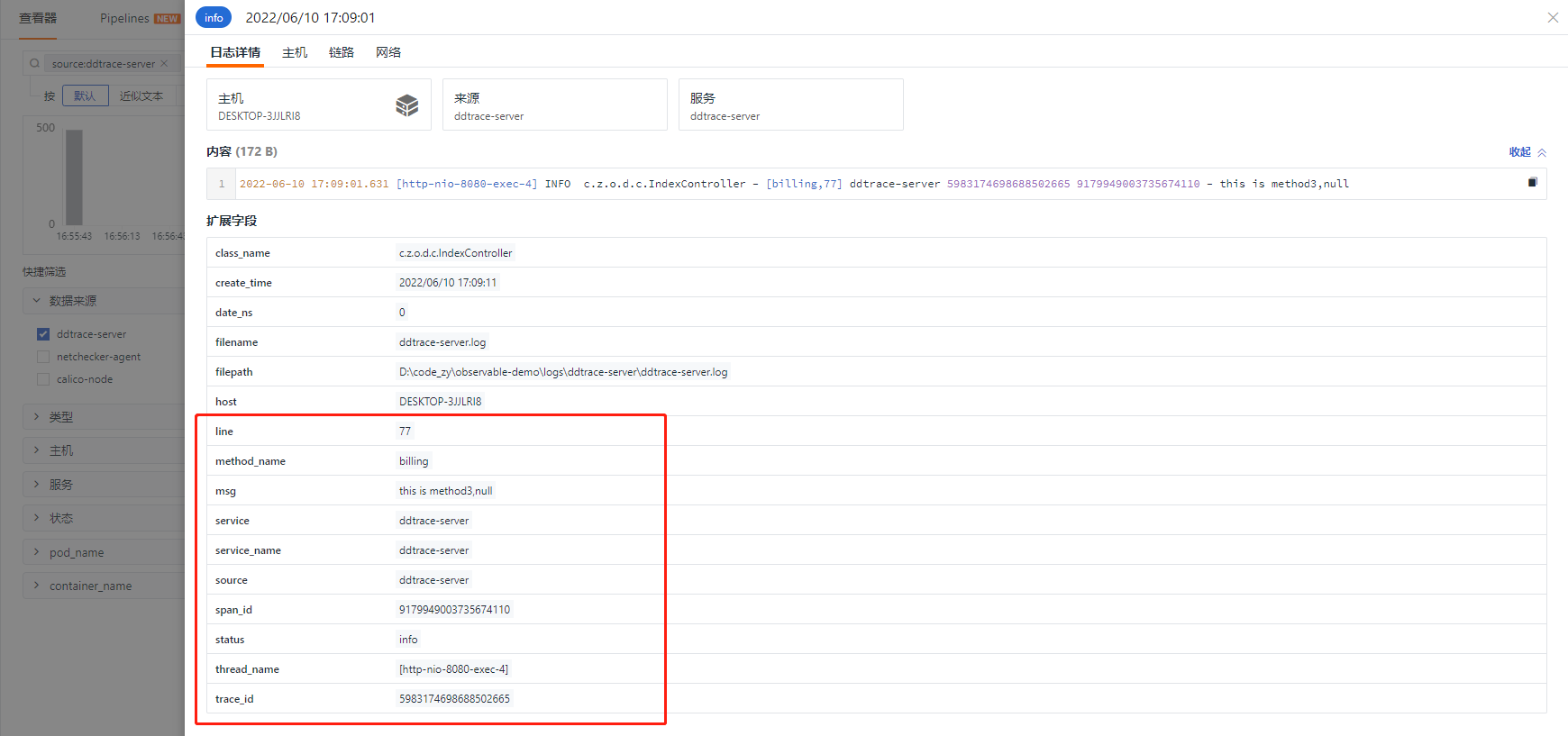
Guance also supports other log collection methods, such as socket. For more log collection, refer to Logs
3 Results
After extracting traceId and spanId from the logs, Guance can directly link from logs to the corresponding trace, achieving trace-log correlation.