Analysis Dashboard
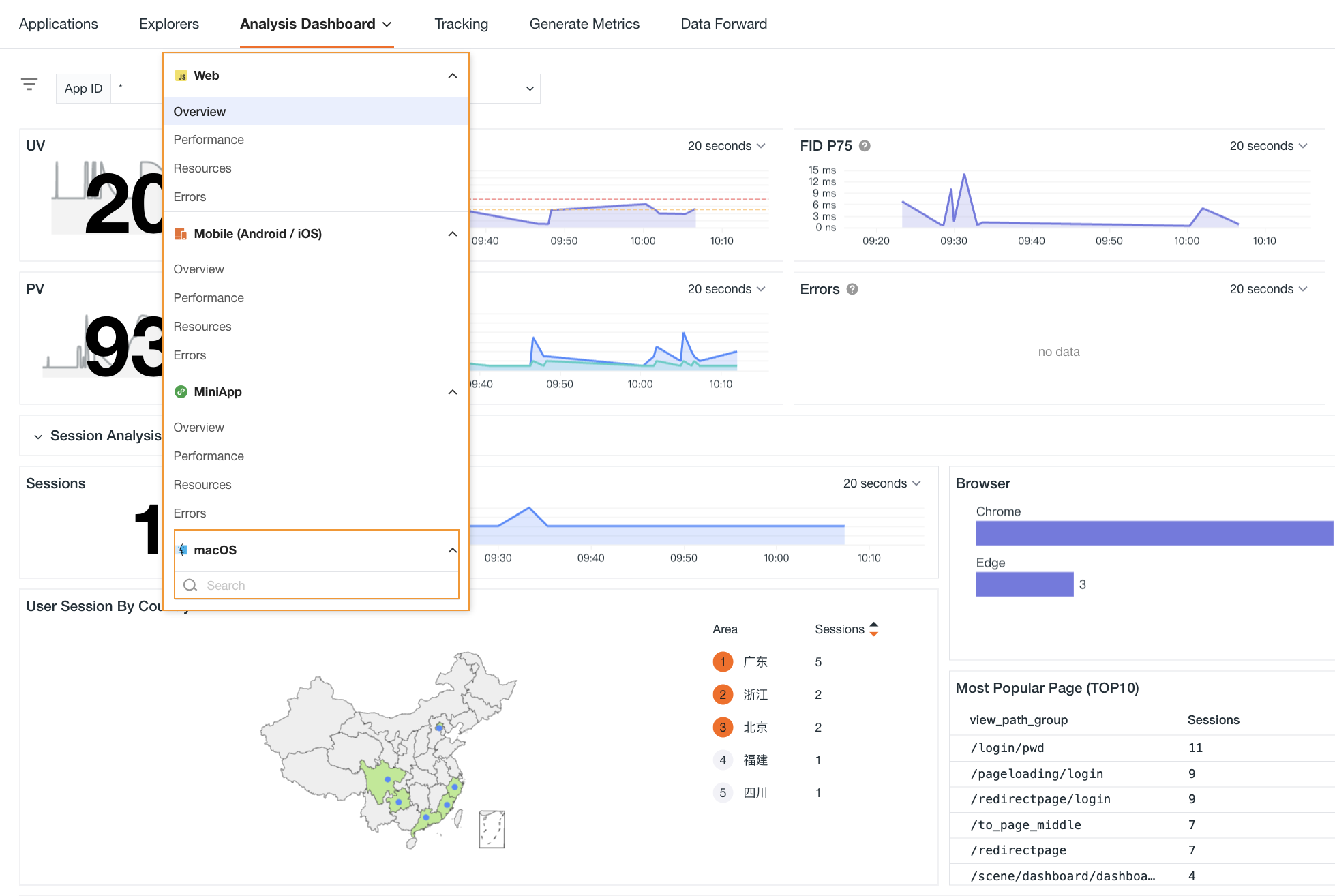
Guance supports visual analysis of applications on different endpoints and provides preset monitoring solutions. After application data is uploaded to Guance, you can directly view the analysis of Web, mobile, mini program, and macOS applications in the monitoring analysis dashboard, covering key analysis dimensions such as Overview, Performance, Resources, and Errors.
Concepts
LCP, FID, and CLS are Google Core Web Vitals used to measure website loading speed, interactivity, and page stability.
| Metric | Description | Target |
|---|---|---|
| LCP (Largest Contentful Paint) | Measures how long it takes for the largest content element in the visible area of the page to load | Less than 2.5s |
| FID (First Input Delay) | Measures the delay when a user first interacts with the page | Less than 100ms |
| CLS (Cumulative Layout Shift) | Measures whether page content shifts due to dynamic loading during page load; 0 means no shift | Less than 0.1 |
Analysis Dimensions
Includes four dimensions:
- Web;
- Mobile (Android / iOS);
- Mini Program;
- macOS Application.
Switch the tabs at the top of the view to switch views.
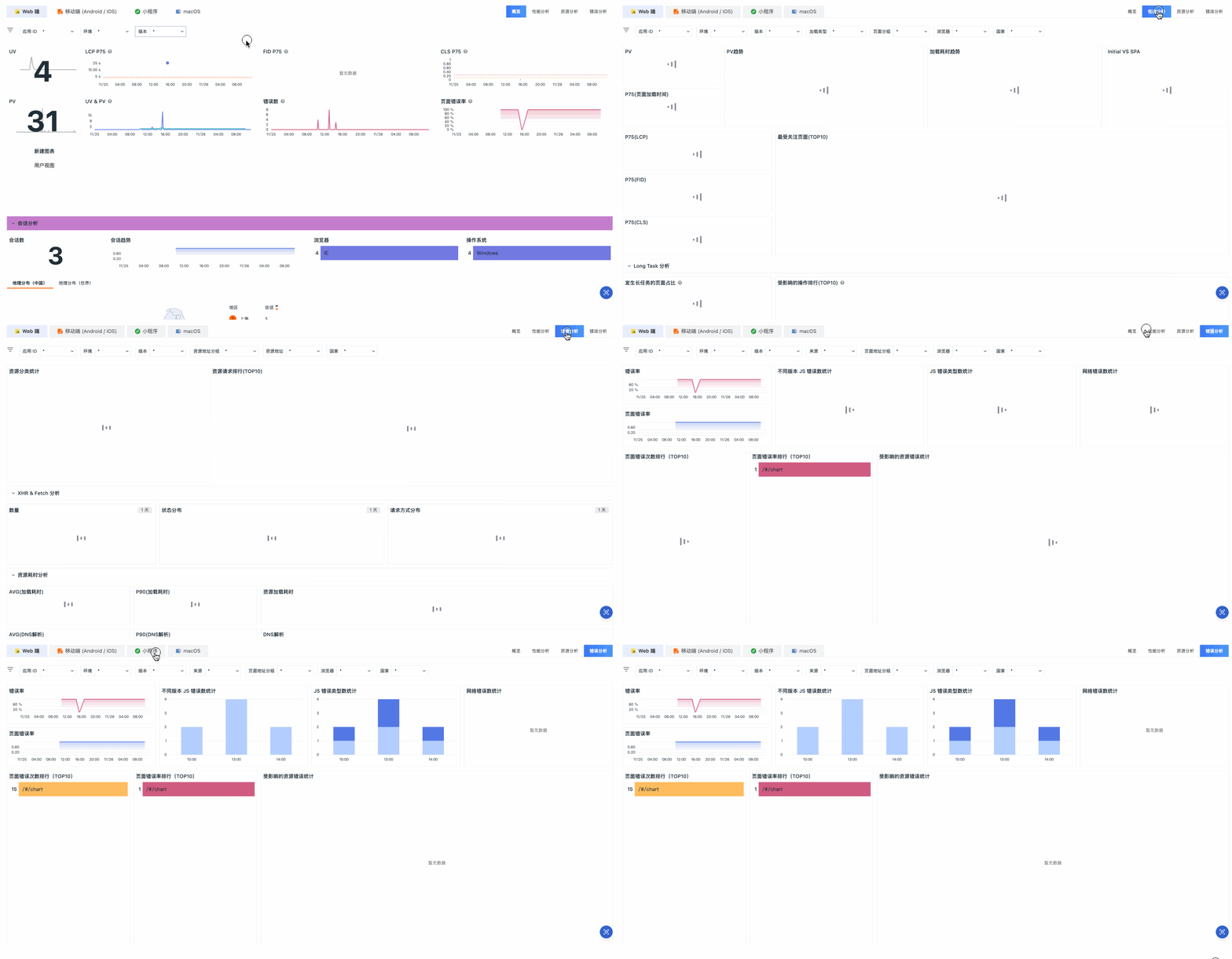
Overview
Tracks metrics such as UV count, PV count, page error rate, and page load time for applications on the current endpoint, and visually presents user access statistics from three perspectives: session analysis, performance analysis, and error analysis, helping you quickly locate issues in user access and improve access performance.
You can quickly locate and view applications that have been connected by filtering by application ID, environment, version, and more.
With the Workspace selector at the top, you can jointly view data from multiple authorized spaces within the same site. When you select a specific application, the data scope is determined by the application and its source space. Applications with the same name or the same application ID in different spaces are not automatically merged. For details, see Workspace and Application Scope. Chart drill-down retains the current query scope. After opening a specific record, the source space of that record is used.
Performance Analysis
Tracks metrics such as PV count, page load time, session counts of the most-viewed pages, page long task analysis, and resource analysis, and provides real-time visibility into overall application page performance from three perspectives: Long Task analysis, XHR & Fetch analysis, and resource analysis, to further pinpoint pages that need optimization.
You can filter by application ID, environment, version, load type, and more.
Resource Analysis
Tracks metrics such as resource classification and resource request ranking, and provides real-time visibility into overall resource status and resources that need optimization from two perspectives: XHR & Fetch analysis and resource duration analysis.
You can filter by application ID, environment, version, resource URL grouping, resource URL, and more.
Error Analysis
Tracks metrics such as error rate, crash version, network error status distribution, and page error rate to quickly locate resource errors.
You can filter by application ID, environment, version, source, page URL grouping, browser, and more.
Related Views
The current analysis dashboard is a standard System View provided by Guance. If you prefer to use a personalized view for analysis, you can create a User View with the same name as the system view, and the system will automatically prioritize your User View for display.
When querying across spaces, existing dashboard configurations are read based on the space to which the application belongs. In this state, you cannot add, pin, or unbind dashboards. To modify configurations, go to the space to which the application belongs and select only the current space.
Click the jump button in the upper-right corner.