User-defined Node Management
In addition to the 14 built-in nodes of Guance, you can create new dial testing nodes globally. By setting up nodes based on different geographical locations and different ISPs, you can perform Synthetic Tests from multiple regions to fully understand the availability of your site.
Create a Node
Go to Synthetic Tests > User-defined Node Management, and click Create.
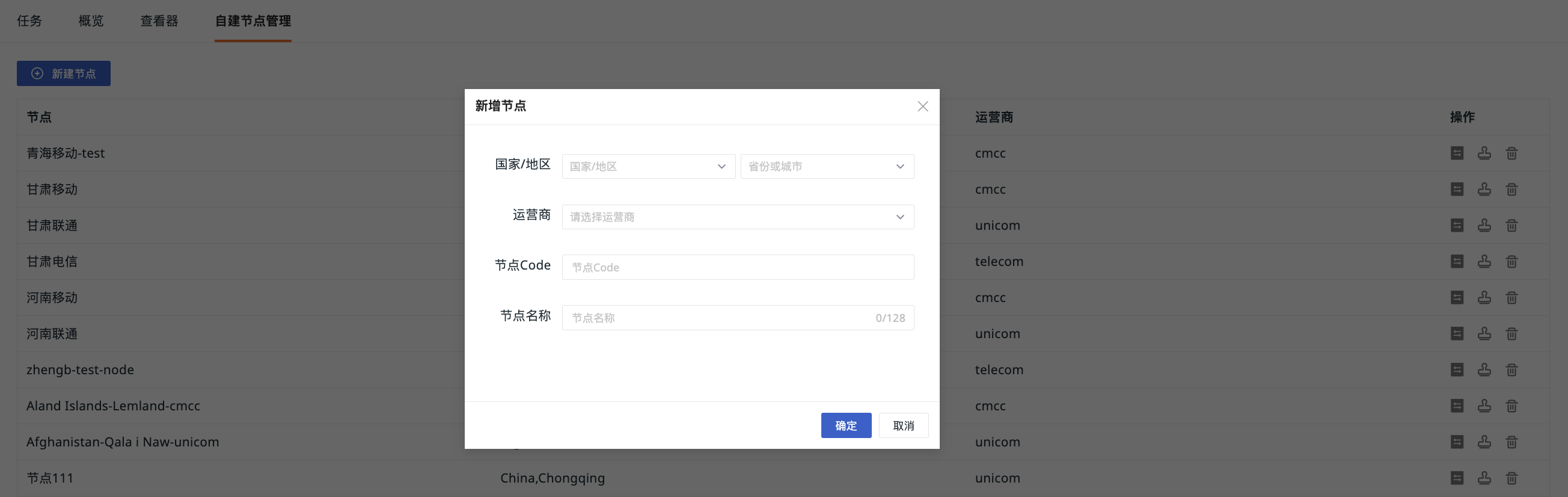
- Select the country/region and province or city;
- Choose the ISP;
- The node code will be automatically filled in; duplicate node codes are not supported within the current workspace;
- Enter the node name; duplicate node names are not supported within the current workspace;
- Click Confirm.
Manage Nodes
In the node list, you can uniformly view and manage all user-defined nodes in the current workspace:
- Click "Get Configuration" to directly copy the configuration information in the pop-up window;
- Click "Audit Logs" to view the operation records related to this node;
- Click "Delete" to delete the current node. If the user-defined node is associated with a Test task, after deletion, this node will no longer report data for that task, but already reported data remains unaffected.

Install Nodes
After creating a node, install DataKit on a host that can reach the test target, then configure the dialtesting collector. The host must also be able to reach the configured server and the DataKit data ingestion endpoint.
Host Deployment
The collector configuration file is <DataKit installation directory>/conf.d/samples/dialtesting.conf. With the default installation paths, the file is:
| Operating System | Configuration File |
|---|---|
| Linux / macOS | /usr/local/datakit/conf.d/samples/dialtesting.conf |
| Windows 64-bit | C:\Program Files\datakit\conf.d\samples\dialtesting.conf |
For other installation paths, see DataKit Installation Directories.
- In User-defined Node Management > Get Configuration, copy the node's
server,region_id,ak, andsk. - Open
conf.d/samplesunder the DataKit installation directory and copydialtesting.conf.sampletodialtesting.conf. If the node is already configured, edit the existing file instead of overwriting it or creating a duplicate configuration. -
In the
[[inputs.dialtesting]]section, replace the existing values with those provided by the console and retain the other settings. Replace all placeholders below with actual values. Do not put this configuration indatakit.conf:To test private network addresses, also set
disable_internal_network_task = falsein the same[[inputs.dialtesting]]section. -
Save the file and restart DataKit. For DataKit 2.1.0 and later, use
datakit service restart; Linux / macOS may requiresudo. For other versions, refer to the corresponding service management commands. - Select this node in a test task. After the task runs, check the reported results in the Test Explorer.
For Kubernetes deployment and the full configuration reference, see Dialtesting Collector Configuration.
Billing
Tests run on user-defined nodes incur both execution and data storage charges. The billable execution count is 1/10 of the public-node count: each Browser Test execution counts as 1 billable execution, and each execution of other test types counts as 0.1 billable executions.
See Synthetic Monitoring Billing for metering rules and Commercial Plan Billing Details for unit prices.